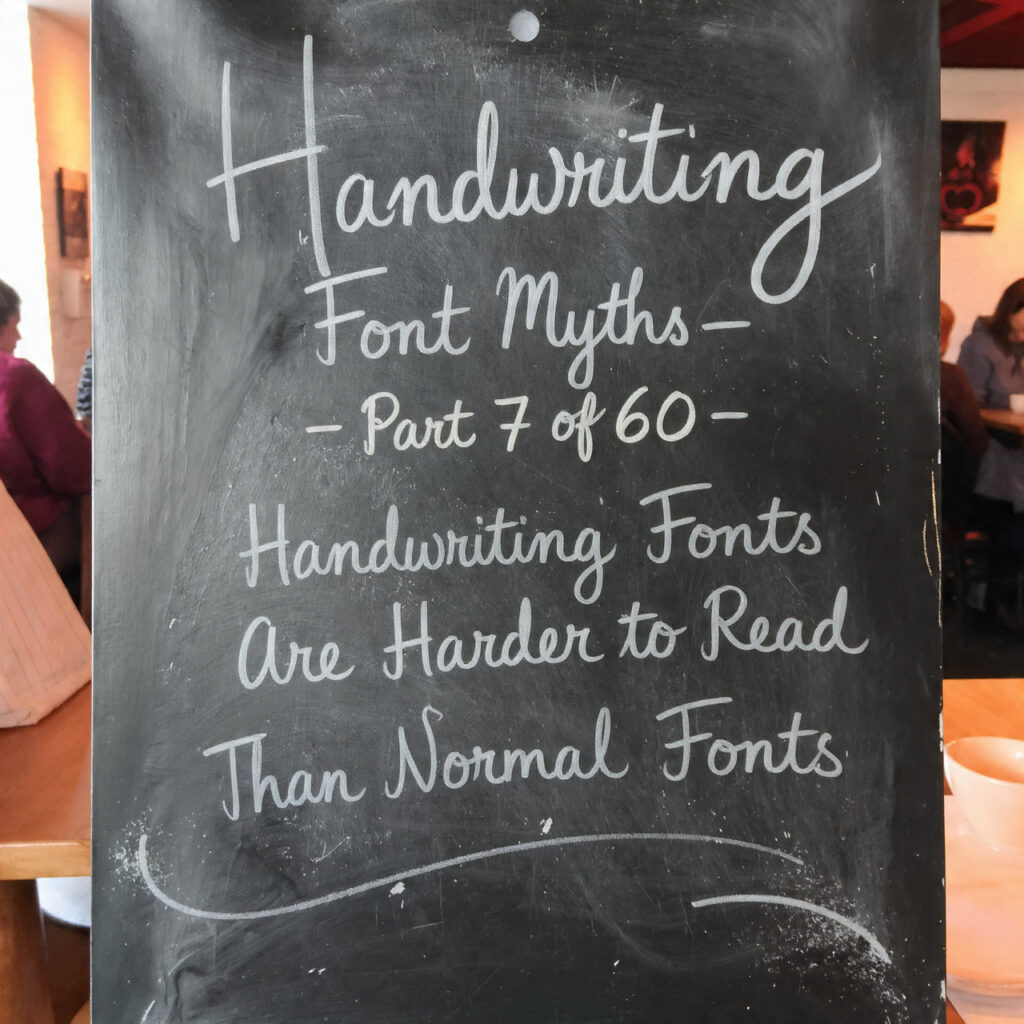
Partially true. Massively overgeneralized. And often used as a reason to avoid an entire category that doesn’t deserve it.
The Myth
The legibility argument against handwriting fonts gets raised often — in design critiques, in brand guidelines that prohibit the category outright, in typography courses that treat conventional serif and sans-serif fonts as the readable ones and everything else as a compromise. The claim tends to go something like this: handwriting fonts are decorative, not functional; they’re fine for one or two words in a headline but become difficult to read in sustained text; anyone who needs their content to be accessible should default to something more neutral.
There’s a kernel of truth in this, which is part of what makes the myth stick. Some handwriting fonts genuinely are harder to read in specific conditions. But the leap from “some handwriting fonts are difficult in some contexts” to “handwriting fonts as a category are less readable” is a significant one — and it doesn’t hold up when examined against what legibility research actually shows, how readers actually behave, or what the real determinants of reading difficulty are.
What Legibility Research Actually Says
Legibility in type is not a simple property that can be ranked cleanly across typeface categories. Research on reading and type legibility consistently points to a cluster of variables that determine how easily readers process text — and most of them have nothing to do with whether a font is classified as a handwriting font or a text font.
The key legibility variables are well-established: x-height (taller x-heights generally improve legibility at small sizes), counter openness (the size of enclosed and semi-enclosed spaces in letters like “e,” “a,” and “o”), stroke contrast (high contrast creates vulnerability at small sizes and in poor printing conditions), letter spacing (too tight or too loose both impair reading), and line spacing (insufficient leading forces the eye to work harder to track lines). These variables operate the same way regardless of whether a font is a humanist sans, a transitional serif, or a casual handwriting design.
A handwriting font with a generous x-height, open counters, moderate stroke contrast, and well-judged spacing can be more legible than a serif font with a compressed x-height, tight counters, and extreme stroke contrast. The categories don’t determine legibility — the specific design decisions within each font do.
Try out and download our best font for free 👀


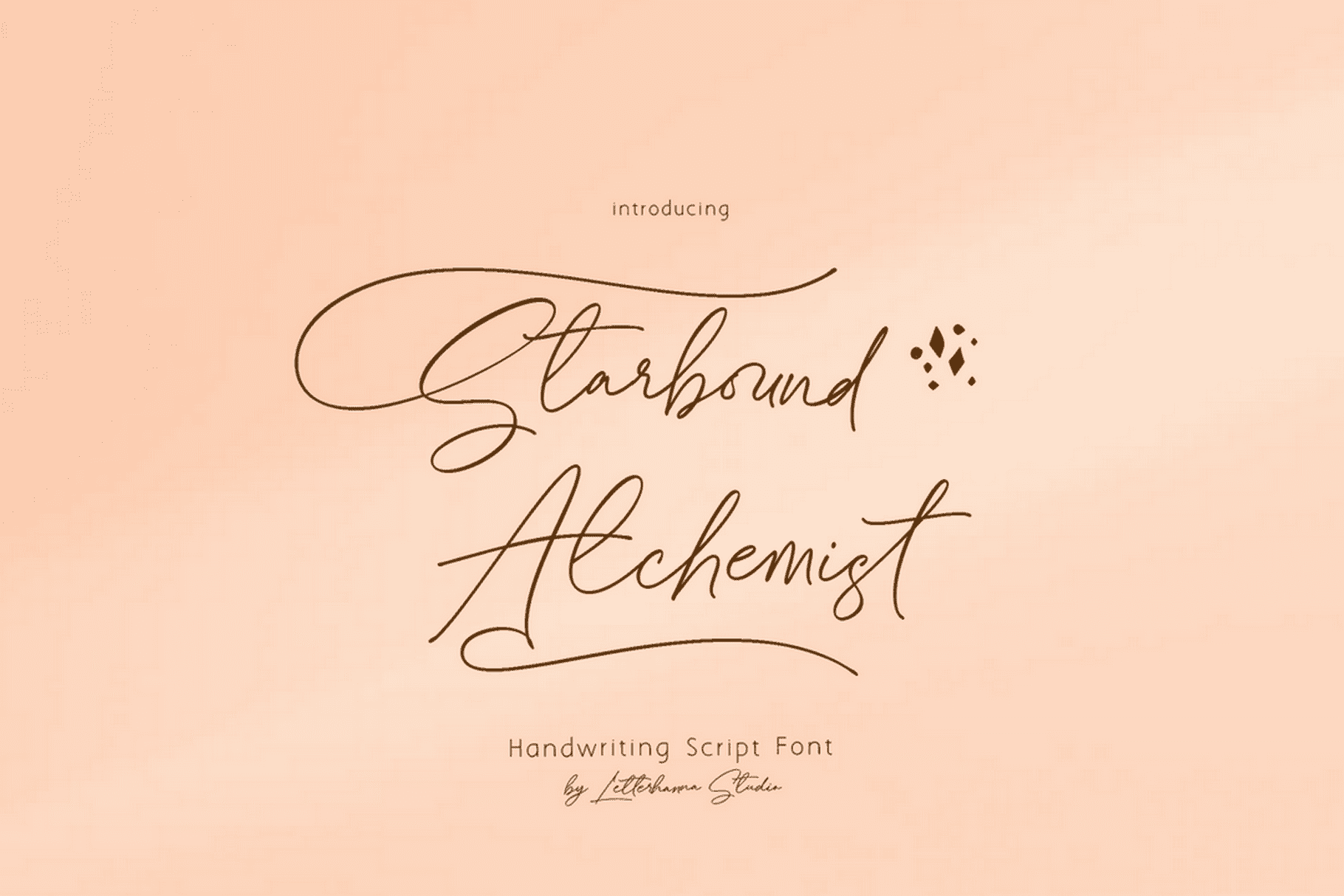

There’s also a significant body of research showing that familiarity plays a major role in reading speed and comprehension. Readers are faster and more accurate with letterforms they encounter frequently. This is part of why conventional text fonts — which readers see constantly — tend to perform well in reading studies: it’s not purely the letterform design, it’s the exposure. A handwriting font that readers encounter regularly in a specific context becomes, over time, just as readable in that context as any familiar text face.
The Conditions Where Handwriting Fonts Genuinely Struggle
None of this means the legibility concern is entirely without basis. There are specific conditions in which handwriting fonts consistently create reading difficulties, and those conditions are worth understanding clearly.
Sustained body text at small sizes. This is where the most legitimate concern lives. Handwriting fonts designed for display use — with high stroke contrast, deliberate irregularity, and complex letterforms — are not engineered for extended reading at 9 or 10pt. The same features that create visual character at headline sizes become sources of fatigue and confusion in sustained small-size text. A reader working through several paragraphs of high-contrast script font at body text size is doing more visual work than one reading the same content in a well-designed text face. This is real, and it matters.
Low-contrast output conditions. Handwriting fonts with fine hairlines perform poorly in printing conditions that can’t reliably reproduce thin strokes — certain digital printing methods, photocopying, thermal printing, very light ink coverage on textured stock. The thin strokes that define the aesthetic break down or disappear, compromising both legibility and the visual integrity of the design. This isn’t a universal problem with handwriting fonts — it’s a problem with high-contrast fonts in demanding production conditions.
Ambiguous letterforms. Some handwriting fonts — particularly those based on highly personal or idiosyncratic handwriting — include letterforms that are genuinely ambiguous. A “1” that reads like an “l,” an “a” that could be a “u,” an “r” and “n” that merge into an apparent “m” at certain sizes — these are design failures in individual fonts, but they do appear in the category more often than in conventionally designed text faces, where legibility testing is typically part of the design process.
Side Note : Promote & earn with Letterhanna’s affiliate program.

Low-familiarity readers. Children learning to read, readers with certain visual processing differences, and readers unfamiliar with particular script styles may find some handwriting fonts more challenging than standard text fonts. This is a real accessibility consideration for specific contexts — educational materials, public-facing signage for general audiences, healthcare communication — where the designer needs to prioritize the broadest possible readability. But “some readers find some handwriting fonts more challenging in specific high-accessibility contexts” is a very different claim from “handwriting fonts are harder to read.”
Where the Myth Overgeneralizes
The jump from the legitimate concerns above to a categorical prohibition on handwriting fonts happens because the specific conditions get dropped and the general category gets condemned.
In practice, handwriting fonts are successfully read every day across a vast range of applications. Café menus in handwriting-style type are read by millions of people without incident. Packaging with brush script product names is legible to anyone who encounters it. Wedding invitation copy in calligraphic script is read without difficulty by people who’ve never taken a typography course. Brand logotypes in flowing script — from Coca-Cola to Ford’s historical wordmarks — are among the most-read typographic forms in the world.
The contexts where these fonts work share some common features: they’re typically used at adequate sizes, in settings where readers approach the text with enough attention to read display or semi-display type, and where the font choice itself signals context in ways that help readers adjust their reading mode. None of these are unusual conditions — they describe the majority of real-world handwriting font use.
The contexts where handwriting fonts struggle — sustained body text at small sizes, poor printing conditions, general-audience low-stakes reading — are real, but they’re the same contexts where many display-category fonts from any typographic tradition struggle. A display slab serif, an ornate blackletter, a condensed headline grotesque — all of these share the same limitations in the same conditions. Singling out handwriting fonts as a category for the legibility concern misidentifies where the actual problem is.
The Right Question
The right question about legibility is never “is this a handwriting font?” It’s always more specific: is this particular font, with its specific design choices about x-height, contrast, spacing, and letterform complexity, appropriate for this reading task, at this size, in this output medium, for this reader?
That question applies equally to every typeface choice. Answering it well requires knowing something about the specific font’s design, understanding the output conditions, and being realistic about the reading task. It does not require avoiding an entire category because some members of that category are inappropriate for some uses.
Here Are Some Fonts You Might Love! 👀