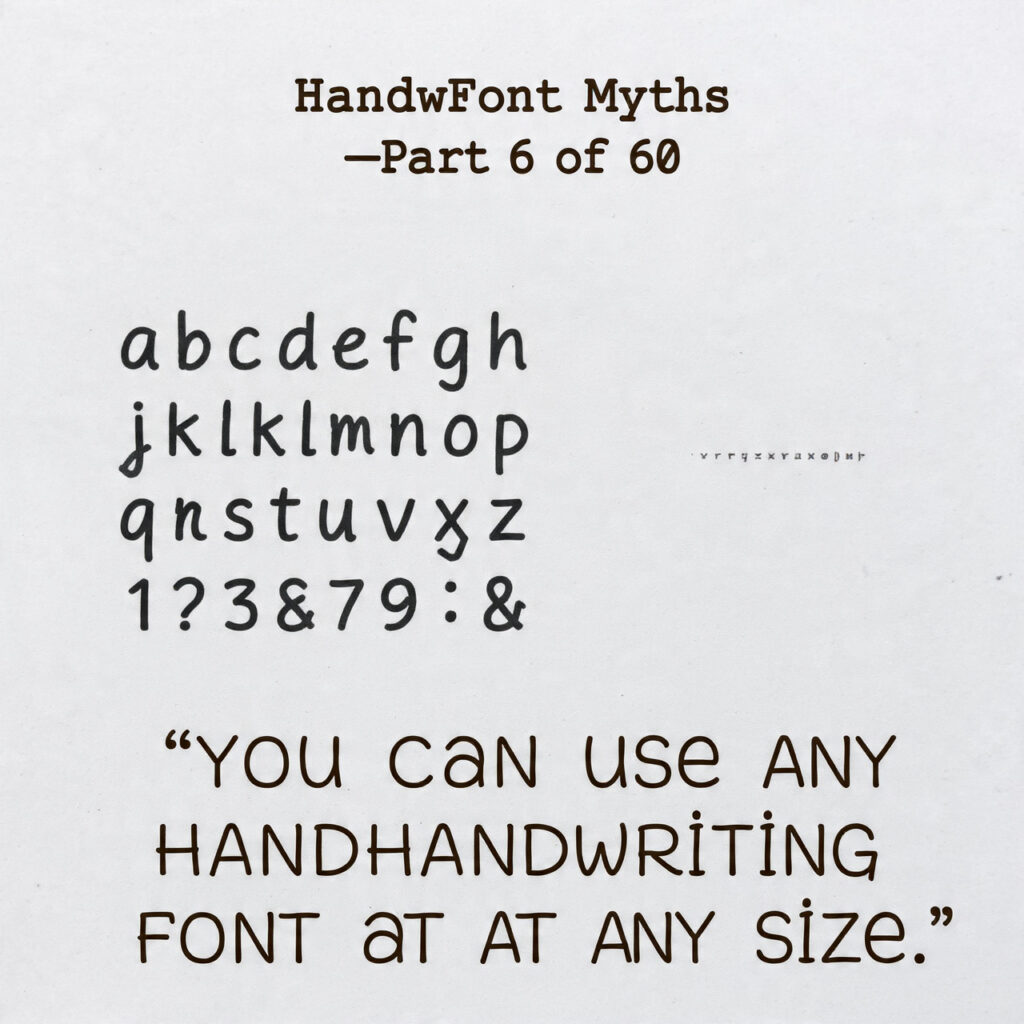
A font that looks perfect at 60pt can be completely illegible at 10pt. This isn’t a mystery — it’s physics.
The Myth
Font selection decisions are often made at the wrong size. A designer opens a font library, scrolls through specimens displayed at 36, 48, or 72pt, finds one that looks exactly right, and buys it. Then the font goes into the actual project — a product label with small-print ingredient text, a business card, a footnote, an app interface — and something is wrong. The font that looked beautiful in the specimen looks cramped, broken, or illegible at the size the project actually needs.
The assumption that makes this mistake possible is straightforward: fonts scale. You pick one, set the size, and the letterforms simply appear larger or smaller as needed. What works at 60pt should work at 10pt, just smaller. If it looks good big, it’ll look fine small.
This assumption ignores a substantial body of knowledge — developed over centuries of metal type design and refined extensively through digital typography — about how and why type behaves differently at different sizes. Handwriting fonts are subject to all of it, often more severely than conventional typefaces.
Why Size Is Not Just Scale
The fundamental issue is that the human visual system doesn’t perceive scaled-down versions of letterforms the same way it perceives letterforms that were designed for small sizes. This isn’t a metaphor or a design preference — it’s an observable feature of how the eye resolves detail, edge contrast, and spatial relationships at different scales.
When a letterform is reduced in size, several things happen simultaneously. Fine details become harder to distinguish. Thin strokes become thinner relative to the resolution of the output medium — they may print poorly, render with aliasing artifacts on screen, or simply disappear below the threshold of visibility. Tight spacing between strokes, which looks refined at large sizes, begins to feel cramped or even merged at small sizes. Open counters — the enclosed or semi-enclosed spaces inside letters like “e,” “a,” and “o” — close up as size decreases, making the letterform harder to read.



Type designers have known about these effects for as long as type design has existed. The response, in the era of metal type, was to cut different versions of the same typeface at different sizes — with deliberately adjusted proportions for each. The small-size version of a Garamond, for instance, had slightly heavier strokes, more open counters, and different spacing than the large-size version. These weren’t just scaled copies. They were different drawings, engineered for different perceptual conditions.
Digital type eliminated the physical constraint of cutting separate metal punches at each size, which was expensive and labor-intensive. But it didn’t eliminate the perceptual reality that made those separate cuts necessary. A single digital font file scaled down to 8pt has the same problems as a large-size metal type face would have if someone tried to use it at 8pt — too thin, too tight, too detailed. The problem has always been there. Digital type just made it easier to create it.
How This Plays Out in Handwriting Fonts
Handwriting fonts are particularly vulnerable to size-related degradation for several reasons that compound the general problem.
High stroke contrast is the most immediate issue. Formal script fonts — Copperplate derivatives, Spencerian-influenced designs, calligraphic scripts — are built around significant variation between thick downstrokes and thin upstrokes and hairlines. At display sizes, this contrast reads as elegance and refinement. At small sizes, the thin strokes become extremely fragile. In offset printing, hairlines below a certain weight will not reproduce reliably — the ink either spreads and fills the fine strokes or fails to transfer at all. On screen, they render at sub-pixel widths that produce aliasing artifacts. The beautiful contrast that defines the font at 60pt becomes a printing liability at 9pt.
Deliberate irregularity amplifies legibility problems. Many handwriting fonts include intentional variation in stroke paths, baseline drift, and letterform geometry — the qualities that make the type feel organic and human. At display size, these qualities read as personality and authenticity. At small sizes, the same variations read as inconsistency and confusion. A slight jag in a stroke path that looks like natural ink behavior at 48pt looks like a broken letter at 10pt. A baseline that drifts attractively at headline size produces text that looks misaligned at body size.
Tight fitting between letters. Handwriting fonts often have close default spacing — letters positioned near each other to suggest the continuous flow of handwriting. At display size, this proximity reads as fluency. At small sizes, adjacent strokes begin to merge visually. An “rn” combination in a tightly-spaced handwriting font can read as “m” at body text size — a legibility failure that would be obvious to any reader but that doesn’t appear at the sizes most specimens display.
Side Note : Promote & earn with Letterhanna’s affiliate program.

Complex letterforms with fine details. Script and calligraphic handwriting fonts often include elaborate swash features, connecting strokes with fine terminals, and flourishes at stroke endings. These details enrich the letterforms at large sizes. At small sizes, they become indistinguishable from the surrounding stroke mass — adding visual weight without contributing any of the intended aesthetic effect. The font ends up looking heavier and darker than intended, with the fine detail work simply lost.
The Optical Size Problem in Practice
The professional consequence of ignoring size behavior is predictable: fonts chosen for their specimen appearance fail in real-world use.
A wedding invitation font selected from a beautiful 48pt specimen gets used to set small-print venue details in 8pt — and the hairlines vanish in offset printing. A brand identity font looks stunning on a website hero image at 80px but becomes illegible in the 12px navigation text. A handwriting-style font selected for packaging design looks perfect in the comps at large size, then goes to production and fails to meet minimum legibility standards for regulatory body text.
These failures are usually attributed to “the font not working” at the project stage, when the actual cause is a mismatch between the size at which the font was evaluated and the size at which it’s being used. The font isn’t broken — it was just never designed for that use case.
What to Look for in Size-Versatile Handwriting Fonts
Some handwriting fonts are designed with small-size performance in mind. They make specific choices that distinguish them from display-only designs.
Low or moderate stroke contrast keeps strokes legible at reduced sizes. An x-height that’s generous relative to the cap height gives more visual mass to the lowercase letters, which is where most text reading happens. Open counters — wider apertures in letters like “e,” “a,” “c” — resist closure as size decreases. Simplified or robust terminals without extremely fine hairline endings hold up in printing and on screen. Slightly more generous default spacing prevents merging at small sizes.
None of these are visible as advantages at display size — they’re engineering choices that only reveal their value when the font is actually used at the sizes a project needs. This is why testing fonts at actual intended use size, not just at specimen scale, is one of the most basic and most frequently skipped steps in professional font selection.
Here Are Some Fonts You Might Love! 👀